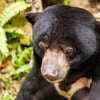
Sun Bear
Helarctos malayanus
Also known as: Malayan Sun Bear, Honey Bear
The Sun Bear (*Helarctos malayanus*) is the smallest bear species in the world, native to the lowland tropical forests of Southeast Asia, including Borneo and Sumatra. Named for the pale, crescent-shaped patch on its chest that resembles a rising sun, it is a solitary, largely nocturnal forager with an exceptionally long tongue adapted for extracting honey and insects from tree hollows. Despite its small size, the Sun Bear plays an outsized ecological role, aerating soil and dispersing seeds as it forages, and its powerful claws make it an agile climber able to build tree-top nests for resting.
Sun Bear Quick Facts
Frequently Asked Questions About the Sun Bear
Sun Bears are found in the lowland tropical forests of Southeast Asia, including Borneo, Sumatra, the Malay Peninsula, and parts of mainland Southeast Asia.
It is an opportunistic omnivore, feeding heavily on insects, termites, and honey, as well as fruit, small vertebrates, and vegetation, using its long tongue and claws to access food in tree hollows and rotten logs.
The Sun Bear is listed as Vulnerable by the IUCN. Its population is declining due to widespread deforestation, poaching for its bile and body parts, and capture for the illegal pet trade.
It is named for the pale, crescent- or U-shaped patch of golden or cream-coloured fur on its chest, which is thought to resemble a rising or setting sun.
The Sun Bear is usually solitary.
The Sun Bear is typically nocturnal/crepuscular.
The Sun Bear is resident.
The main threats facing the Sun Bear include Deforestation and habitat loss, Poaching for bile and body parts, and Capture for the illegal pet trade.
The Sun Bear population trend is currently decreasing.
Well-known places to look for the Sun Bear include Bornean Sun Bear Conservation Centre (Sabah, Borneo), Danum Valley Conservation Area (Sabah, Borneo), and Kinabatangan River (Sabah, Borneo).
Natural predators of the Sun Bear include Tigers, Clouded leopards, and Reticulated pythons (for cubs).
Long targeted for traditional medicine due to its bile, a practice that has driven significant conservation efforts across Southeast Asia, including dedicated rescue centres such as the one in Sepilok.
The Sun Bear is part of the Ursidae family and a Carnivora order.
The Sun Bear weighs about 50 kg, stands around 70 cm tall, and reaches about 140 cm in length.