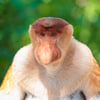
Proboscis Monkey
Nasalis larvatus
Also known as: Long-nosed monkey, Monyet Belanda
The Proboscis Monkey (*Nasalis larvatus*) is a highly specialized primate endemic to the island of Borneo, famous for the male's large, pendulous nose which is believed to attract mates and amplify vocalizations. These reddish-brown monkeys are uniquely adapted to riverine forests, coastal mangroves, and peat swamp habitats. They are exceptional swimmers, possessing partially webbed toes that help them navigate Bornean waterways, and they are known to leap from high branches directly into rivers, sometimes from heights of up to 15 meters. Proboscis monkeys live in organized social groups, usually consisting of harem groups with a single dominant male and several females, or all-male bachelor groups. Their diet is highly specific, relying on a complex, multi-chambered stomach filled with specialized bacteria to ferment and digest tough mangrove leaves and unripe seeds, making them highly vulnerable to habitat fragmentation.
Proboscis Monkey Quick Facts
Frequently Asked Questions About the Proboscis Monkey
Proboscis Monkeys are endemic to the island of Borneo, meaning they are found nowhere else in the wild. They live in coastal, riverine, and mangrove swamp forests.
The Proboscis Monkey feeds primarily on leaves, seeds, mangrove shoots, and unripe fruits. They avoid ripe fruits because sugar fermentation causes severe bloating.
The Proboscis Monkey is listed as Endangered, with a decreasing population trend. Main threats include habitat fragmentation due to clearing of riverine forests for agriculture, and hunting.
The Proboscis Monkey is usually harems (one male, multiple females).
The Proboscis Monkey is typically diurnal.
The Proboscis Monkey is resident.
The main threats facing the Proboscis Monkey include Habitat fragmentation, Logging, Agricultural expansion, and Hunting.
The Proboscis Monkey population trend is currently decreasing.
Well-known places to look for the Proboscis Monkey include Labuk Bay Proboscis Monkey Sanctuary (Sabah, Borneo) and Bako National Park (Sarawak, Borneo).
Natural predators of the Proboscis Monkey include Crocodiles, Clouded leopards, Pythons, and Crested serpent eagles.
One of the most famous endemic species of Borneo, highlighting the importance of conserving mangrove ecosystems.
The Proboscis Monkey is part of the Cercopithecidae family and a Primates order.
The Proboscis Monkey weighs about 17 kg, stands around 65 cm tall, and reaches about 65 cm in length.
The Proboscis Monkey can reach speeds of around 24 km/h.