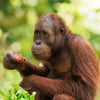
Orangutan
Pongo pygmaeus
Also known as: Red Ape, Mawas
Orangutans are the largest arboreal mammals on Earth, immediately recognizable by their shaggy reddish-brown hair and remarkably long, powerful arms, which can reach a span of over two meters. Native to the rainforests of Borneo and Sumatra, these highly intelligent great apes spend nearly their entire lives in the canopy, using their hook-like hands and flexible hip joints to traverse the treetops. They share approximately 97% of their DNA with humans and demonstrate advanced cognitive abilities, including the sophisticated use of tools for foraging and shelter. Unlike other great apes, orangutans are primarily solitary, with adult males establishing large territories and communicating with resonant 'long calls' that echo through the forest. Every evening, they construct a new, elaborate nest out of branches and leaves high in the trees to sleep safely away from ground predators, showing a high degree of foresight and planning.
Orangutan Quick Facts
Frequently Asked Questions About the Orangutan
Orangutans are native to Southeast Asia and can be found exclusively on the islands of Borneo and Sumatra, living in tropical rainforests and peat swamp forests.
Orangutans feed mainly on fruits (such as durian and figs), but they also consume leaves, bark, shoots, honey, and insects, making them frugivores and opportunistic omnivores.
All species of orangutans are listed as Critically Endangered, with a rapidly decreasing population trend. Main threats include habitat destruction from logging and palm oil plantations, poaching, and the illegal pet trade.
The Orangutan is usually solitary.
The Orangutan is typically diurnal.
The Orangutan is resident.
The main threats facing the Orangutan include Deforestation for palm oil plantations, Logging, Illegal pet trade, and Forest fires.
The Orangutan population trend is currently decreasing.
Well-known places to look for the Orangutan include Sepilok Orangutan Rehabilitation Centre (Sabah, Borneo) and Tanjung Puting National Park (Kalimantan, Borneo).
Natural predators of the Orangutan include Sumatran tigers, Clouded leopards, and Crocodiles.
A critical umbrella species for rainforest conservation. The name 'orangutan' translates from Malay as 'person of the forest'.
The Orangutan is part of the Hominidae family and a Primates order.
The Orangutan weighs about 55 kg, stands around 130 cm tall, and reaches about 130 cm in length.
The Orangutan can reach speeds of around 5 km/h.