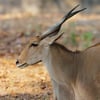
Common Eland
Taurotragus oryx
Also known as: Southern Eland, Eland Antelope
The Common Eland is one of the world's largest antelope species, native to savannas, grasslands, and open woodlands across eastern and southern Africa. Despite its heavy build, it is surprisingly agile and capable of clearing impressive heights when startled. Common elands are adaptable mixed feeders, browsing leaves and shrubs as well as grazing grasses, and they often move in loose herds that shift in size depending on food, water, and season.
Common Eland Quick Facts
Frequently Asked Questions About the Common Eland
The Common Eland lives across parts of eastern and southern Africa, using savannas, grasslands, scrub, and open woodland where food and water are available.
The Common Eland is a mixed feeder, browsing leaves and shrubs while also grazing grasses and herbs, especially after rainfall.
The Common Eland is currently listed as Least Concern, although local populations can be affected by habitat loss, hunting, fencing, and competition with livestock.
The Common Eland is usually loose herds.
The Common Eland is typically diurnal and crepuscular.
The Common Eland is nomadic movements.
The main threats facing the Common Eland include Habitat loss, Hunting, Fencing, and Competition with livestock.
The Common Eland population trend is currently stable.
Well-known places to look for the Common Eland include Kruger National Park (South Africa), Etosha National Park (Namibia), and Serengeti ecosystem (Tanzania).
Natural predators of the Common Eland include Lions, Spotted hyenas, and African wild dogs.
A significant antelope in southern African rock art and folklore, often associated with strength, endurance, and abundance.
The Common Eland is part of the Bovidae family and an Artiodactyla order.
The Common Eland weighs about 600 kg, stands around 170 cm tall, and reaches about 280 cm in length.
The Common Eland can reach speeds of around 40 km/h.