Von der Decken's Hornbill
Tockus deckeni
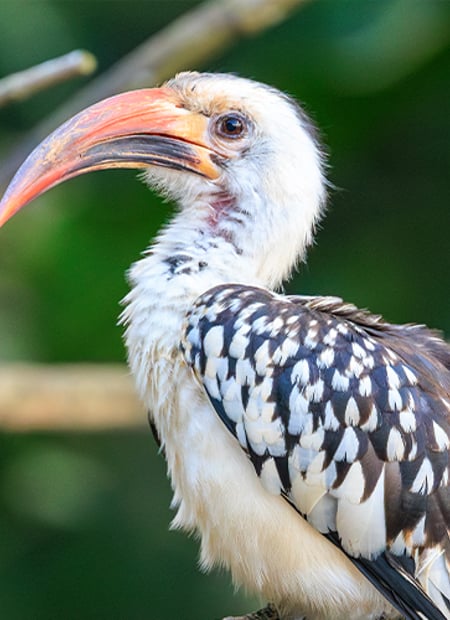
Von der Decken's Hornbill is a small, striking hornbill native to the dry savannas and scrublands of East Africa. It exhibits strong sexual dimorphism; males possess a bright red and yellow bill, while females have a simple, solid black bill. They have a fascinating cooperative relationship with dwarf mongooses, foraging together on the ground and warning each other of incoming predators.
Von der Decken's Hornbill Quick Facts
Frequently Asked Questions About the Von der Decken's Hornbill
Males have a bright orange-red bill with a yellow tip, whereas females have a completely black bill.
Like other hornbills, the female seals herself inside a tree cavity using mud and droppings, leaving a tiny slit for the male to feed her.
The Von der Decken's Hornbill is usually pairs or small family groups.
The Von der Decken's Hornbill is typically diurnal.
The Von der Decken's Hornbill is resident.
The main threats facing the Von der Decken's Hornbill include Habitat clearing and Loss of nesting trees.
The Von der Decken's Hornbill population trend is currently stable.
Well-known places to look for the Von der Decken's Hornbill include Tsavo National Park (Kenya), Serengeti National Park (Tanzania), and Tarangire National Park (Tanzania).
Natural predators of the Von der Decken's Hornbill include Large birds of prey and Snakes.
Named in honor of the German explorer Baron Karl Klaus von der Decken, who traveled extensively in East Africa.
The Von der Decken's Hornbill is part of the Bucerotidae family and a Bucerotiformes order.
The Von der Decken's Hornbill weighs about 0.17 kg, stands around 48 cm tall, and reaches about 48 cm in length.
The Von der Decken's Hornbill can reach speeds of around 30 km/h.