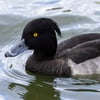
Tufted Duck
Aythya fuligula
Also known as: Tufted Pochard
The Tufted Duck is a small diving duck widespread across Eurasia and parts of Africa. Males are distinctive with black backs, white flanks and a tuft at the back of the head; females are browner with a less pronounced tuft. They dive for molluscs, aquatic insects and plant material in freshwater lakes and reservoirs.
Tufted Duck Quick Facts
Frequently Asked Questions About the Tufted Duck
The Tufted Duck is migratory and is associated with Lakes, reservoirs, coastal lagoons in Eurasia, parts of Africa.
The Tufted Duck can be found in Eurasia, parts of Africa and is most often associated with Lakes, reservoirs, coastal lagoons.
The Tufted Duck feeds on Molluscs, aquatic insects, plant matter and is considered a omnivore.
The Tufted Duck is currently listed as Least Concern, with a stable population trend. Main threats include Water pollution, Loss of nesting habitat.
The Tufted Duck is usually gregarious (large flocks).
The Tufted Duck is typically diurnal.
The main threats facing the Tufted Duck include Water pollution and Loss of nesting habitat.
The Tufted Duck population trend is currently stable.
Well-known places to look for the Tufted Duck include British Park Lakes and Caspian Sea.
Natural predators of the Tufted Duck include Foxes, Eagles, and Pike.
A familiar and friendly sight on European public park ponds.
The Tufted Duck is part of the Anatidae family and an Anseriformes order.
The Tufted Duck weighs about 0.75 kg, stands around 45 cm tall, reaches about 45 cm in length, and has a wingspan of about 70 cm.
The Tufted Duck can reach speeds of around 60 km/h.