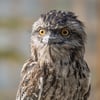
Tawny Frogmouth
Podargus strigoides
Also known as: Mopoke
The Tawny Frogmouth is a nocturnal bird often mistaken for an owl, though it is actually more closely related to nightjars. Native to Australia, it is a master of camouflage; when threatened, it freezes and stretches its neck upwards to resemble a broken tree branch. Unlike owls which use talons to catch prey, frogmouths catch insects and small animals with their wide, frog-like beaks.
Tawny Frogmouth Quick Facts
Frequently Asked Questions About the Tawny Frogmouth
The Tawny Frogmouth can be found in Australia and is most often associated with Woodlands, forests, and urban areas.
The Tawny Frogmouth feeds on Insects, spiders, small vertebrates and is considered a carnivore/insectivore.
The Tawny Frogmouth is currently listed as Least Concern, with a stable population trend. Main threats include Pesticides, Habitat loss, Vehicle strikes.
The Tawny Frogmouth is usually pairs.
The Tawny Frogmouth is typically nocturnal.
The Tawny Frogmouth is resident.
The main threats facing the Tawny Frogmouth include Pesticides, Habitat loss, and Vehicle strikes.
The Tawny Frogmouth population trend is currently stable.
Well-known places to look for the Tawny Frogmouth include Australian Botanic Gardens and Centennial Park (Sydney).
Natural predators of the Tawny Frogmouth include Cats, Foxes, and Pythons.
Iconic Australian bird famous for its 'dead branch' pose.
The Tawny Frogmouth is part of the Podargidae family and a Podargiformes order.
The Tawny Frogmouth weighs about 0.45 kg, stands around 45 cm tall, reaches about 46 cm in length, and has a wingspan of about 80 cm.
The Tawny Frogmouth can reach speeds of around 30 km/h.