Stork-billed Kingfisher
Pelargopsis capensis
Also known as: Stork-billed Kinghunter
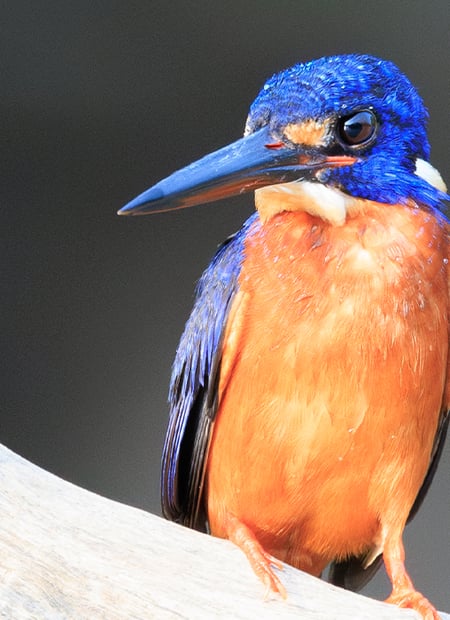
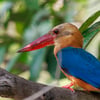
The Stork-billed Kingfisher is a large, brightly colored tree kingfisher widely distributed across South and Southeast Asia. It is easily identified by its massive, dagger-like red bill, bright blue back, and warm buff-orange underparts. It is a highly territorial bird that perches quietly in the shade of trees along rivers, lakes, and coasts, diving down to catch fish, frogs, crabs, and even small birds and rodents.
Stork-billed Kingfisher Quick Facts
Frequently Asked Questions About the Stork-billed Kingfisher
It hunts from a quiet, shady perch overlooking the water, sitting motionlessly before plunging down to seize prey with its massive bill. It then flies back to the branch to beat the prey against it before swallowing.
It is one of the largest kingfisher species in the world, reaching a length of about 35 cm (14 inches) with a remarkably large and heavy bill.
The Stork-billed Kingfisher is usually solitary/pairs (territorial).
The Stork-billed Kingfisher is typically diurnal.
The Stork-billed Kingfisher is resident.
The main threats facing the Stork-billed Kingfisher include Habitat destruction, Water pollution, and Deforestation.
The Stork-billed Kingfisher population trend is currently stable.
Well-known places to look for the Stork-billed Kingfisher include Sundarbans (India/Bangladesh), Kinabatangan River (Borneo), and Periyar National Park (India).
Natural predators of the Stork-billed Kingfisher include Raptors and Snakes (on nests).
One of the most impressive and largest kingfishers in the world, frequently depicted in regional bird guide books.
The Stork-billed Kingfisher is part of the Alcedinidae family and a Coraciiformes order.
The Stork-billed Kingfisher weighs about 0.22 kg, stands around 35 cm tall, reaches about 35 cm in length, and has a wingspan of about 45 cm.
The Stork-billed Kingfisher can reach speeds of around 45 km/h.