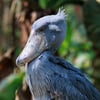
Shoebill
Balaeniceps rex
Also known as: Whalehead, Shoe-billed Stork
The Shoebill is a large, prehistoric-looking bird native to the swamps and wetlands of East Africa. It is most famous for its massive, shoe-shaped bill, which it uses to decapitate large prey such as lungfish, eels, and even baby crocodiles. These birds are solitary and silent hunters, capable of standing motionless for hours before collapsing forward with incredible speed to engulf their target.
Shoebill Quick Facts
Frequently Asked Questions About the Shoebill
The Shoebill is nomadic and is associated with Brackish waters and alkaline lakes in East Africa.
The Shoebill can be found in East Africa and is most often associated with Brackish waters and alkaline lakes.
The Shoebill feeds on Fish, amphibians, reptiles and is considered a piscivore.
The Shoebill is currently listed as Vulnerable, with a decreasing population trend. Main threats include Habitat loss, Disturbance, Illegal capture.
The Shoebill is usually solitary.
The Shoebill is typically diurnal (often active at night).
The main threats facing the Shoebill include Habitat loss, Disturbance, and Illegal capture.
The Shoebill population trend is currently decreasing.
Well-known places to look for the Shoebill include Mabamba Swamp (Uganda) and Sudd (South Sudan).
Natural predators of the Shoebill include Humans and Large crocodilians.
Iconic flagship species for African wetlands.
The Shoebill is part of the Balaenicipitidae family and a Pelecaniformes order.
The Shoebill weighs about 5.6 kg, stands around 120 cm tall, reaches about 120 cm in length, and has a wingspan of about 260 cm.
The Shoebill can reach speeds of around 30 km/h.