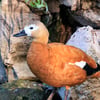
Ruddy Shelduck
Tadorna ferruginea
Also known as: Brahminy Duck, Ruddy Sheldrake
The Ruddy Shelduck (*Tadorna ferruginea*) is a striking, orange-brown waterfowl distinguished by its rich cinnamon plumage, pale creamy head, and glossy black tail and flight feathers. Breeding populations range across northwestern Africa, southeastern Europe, Central Asia, and China, wintering in the Indian subcontinent. Inhabiting lakes, rivers, and high-altitude wetlands, it feeds on plant shoots, seeds, and aquatic invertebrates while maintaining strong, lifelong pair bonds.
Ruddy Shelduck Quick Facts
Frequently Asked Questions About the Ruddy Shelduck
Yes, northern populations in Central Asia migrate south to winter in India and South Asia, while some populations in North Africa and parts of Europe are resident.
It inhabits open water bodies including freshwater lakes, brackish rivers, alpine tarns, and reservoirs in Central Asia, Europe, and South Asia.
The Ruddy Shelduck is an omnivore, feeding on seeds, plant shoots, aquatic vegetation, insects, molluscs, and small crustaceans.
The Ruddy Shelduck is classified as Least Concern, with a large global range, though local populations face wetland habitat degradation and disturbance.
The Ruddy Shelduck is usually pairs/small flocks.
The Ruddy Shelduck is typically diurnal.
The main threats facing the Ruddy Shelduck include Wetland habitat loss, Pollution, and Hunting and disturbance.
The Ruddy Shelduck population trend is currently stable.
Well-known places to look for the Ruddy Shelduck include Qinghai Lake (China), Keoladeo National Park (India), and Lake Van (Turkey).
Natural predators of the Ruddy Shelduck include Foxes, Eagles and large raptors, and Snakes (on eggs).
Revered in Tibetan Buddhism where it is regarded as a sacred bird and symbol of fidelity.
The Ruddy Shelduck is part of the Anatidae family and an Anseriformes order.
The Ruddy Shelduck weighs about 1.3 kg, stands around 60 cm tall, reaches about 64 cm in length, and has a wingspan of about 125 cm.
The Ruddy Shelduck can reach speeds of around 65 km/h.