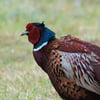
Ring-necked Pheasant
Phasianus colchicus
Also known as: Common Pheasant, Colchicus Pheasant
The Ring-necked Pheasant is a large, colorful gamebird native to Asia but widely introduced across Europe, North America, and other parts of the world. The males are highly ornate, showcasing iridescent green and copper plumage, red facial skin, and a distinctive white collar ring around the neck, while females are a cryptic mottled brown. They are ground-dwelling birds that prefer open fields, brushy areas, and agricultural landscapes, where they forage for seeds, grains, berries, and insects.
Ring-necked Pheasant Quick Facts
Frequently Asked Questions About the Ring-necked Pheasant
No, Ring-necked Pheasants are native to Asia. They were introduced to Europe in the Middle Ages and to North America in the late 19th century as gamebirds.
They show strong sexual dimorphism. Males (cocks) are brightly colored with red facial skin and white neck rings, while females (hens) are a camouflaged brown to protect them while nesting.
The Ring-necked Pheasant is usually polygynous (harems during breeding).
The Ring-necked Pheasant is typically diurnal.
The Ring-necked Pheasant is resident.
The main threats facing the Ring-necked Pheasant include Habitat destruction, Intensive agriculture, and Hunting.
The Ring-necked Pheasant population trend is currently stable.
Well-known places to look for the Ring-necked Pheasant include Midwestern United States, East Anglia (UK), and Sichuan Province (China).
Natural predators of the Ring-necked Pheasant include Foxes, Hawks, Coyotes, and Feral cats.
One of the world's most hunted and managed gamebirds, widely featured in sporting art.
The Ring-necked Pheasant is part of the Phasianidae family and a Galliformes order.
The Ring-necked Pheasant weighs about 1.2 kg, stands around 60 cm tall, reaches about 80 cm in length, and has a wingspan of about 75 cm.
The Ring-necked Pheasant can reach speeds of around 60 km/h.