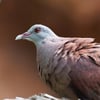
Red Turtle-Dove
Streptopelia tranquebarica
The Red Turtle-Dove is a small, compact dove native to South and Southeast Asia. Males are striking, with deep brick-red upperparts, a blue-grey head, and a black half-collar on the nape, while females are a more subdued brownish-grey. Common across open woodland, scrubland, and agricultural land, it is often seen in flocks feeding on the ground. A partial migrant, northern populations move south during winter, making it a familiar sight across much of the region throughout the year.
Red Turtle-Dove Quick Facts
Frequently Asked Questions About the Red Turtle-Dove
The Red Turtle-Dove is found across South and Southeast Asia, from Pakistan and India through to southern China, the Philippines, and Indonesia, preferring open woodland, scrubland, and farmland.
It feeds primarily on seeds and grains gathered from the ground, and will occasionally take small insects, particularly during the breeding season.
It is a partial migrant — northern populations move to warmer southern areas during winter, while populations further south tend to be resident year-round.
Males are distinctive with rich brick-red upperparts, a blue-grey head, and a black half-collar. Females and juveniles are much plainer, showing brownish-grey plumage overall.
The Red Turtle-Dove is usually flocks and pairs.
The Red Turtle-Dove is typically diurnal.
The main threats facing the Red Turtle-Dove include Habitat loss and Hunting and trapping.
The Red Turtle-Dove population trend is currently stable.
Well-known places to look for the Red Turtle-Dove include Keoladeo National Park (India), Doi Inthanon (Thailand), and Luzon (Philippines).
Natural predators of the Red Turtle-Dove include Raptors, Snakes, and Cats.
The Red Turtle-Dove is part of the Columbidae family and a Columbiformes order.
The Red Turtle-Dove weighs about 0.1 kg, reaches about 23 cm in length, and has a wingspan of about 38 cm.