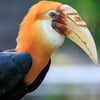
Papuan Hornbill
Rhyticeros plicatus
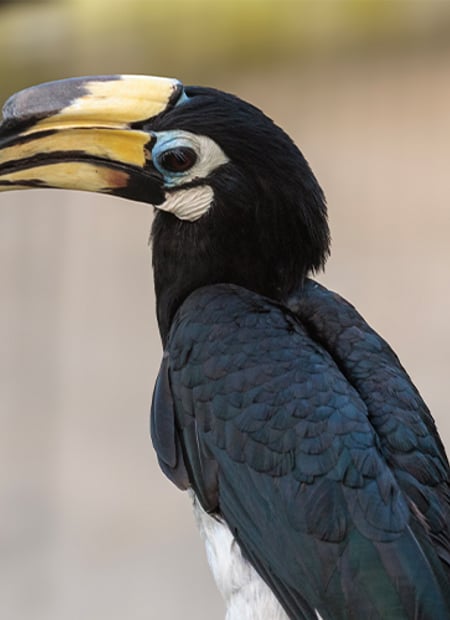
The Papuan Hornbill is one of the largest and most striking birds of the New Guinea region, a frugivorous giant of lowland and hill forests that ranges across Papua New Guinea, the Solomon Islands, and the Maluku Islands. Males are unmistakable: a creamy white head and neck contrast sharply with jet-black body plumage, while the large corrugated casque atop the bill turns deep rufous-orange in adult males. Females are entirely black with bare blue facial skin, making the sexes look like different species. Like other hornbills, they are cavity nesters the female seals herself inside a hollow tree using mud, droppings, and food remains, leaving only a narrow slit through which the male passes fruit for weeks at a time.
Papuan Hornbill Quick Facts
Frequently Asked Questions About the Papuan Hornbill
The Papuan Hornbill is found in lowland and hill rainforests across New Guinea, the Solomon Islands, and the Maluku Islands, typically below 1,500 metres elevation.
The Papuan Hornbill is primarily frugivorous, relying heavily on figs and other forest fruits. It will also take small vertebrates, insects, and lizards opportunistically.
The Papuan Hornbill is currently listed as Least Concern by the IUCN, though its population is declining due to deforestation, hunting for its casque and feathers, and trapping for the cage-bird trade.
The Papuan Hornbill is usually pairs or small groups.
The Papuan Hornbill is typically diurnal.
The Papuan Hornbill is resident.
The main threats facing the Papuan Hornbill include Deforestation and logging, Hunting for feathers and casques, and Trapping for the cage-bird trade.
The Papuan Hornbill population trend is currently decreasing.
Well-known places to look for the Papuan Hornbill include Varirata National Park (Papua New Guinea), Tari Valley (Papua New Guinea), and Nimbokrang (West Papua, Indonesia).
Natural predators of the Papuan Hornbill include Large raptors and Pythons.
The Papuan Hornbill is part of the Bucerotidae family and a Bucerotiformes order.
The Papuan Hornbill weighs about 2 kg, reaches about 90 cm in length, and has a wingspan of about 145 cm.