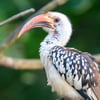
Northern Red-billed Hornbill
Tockus erythrorhynchus
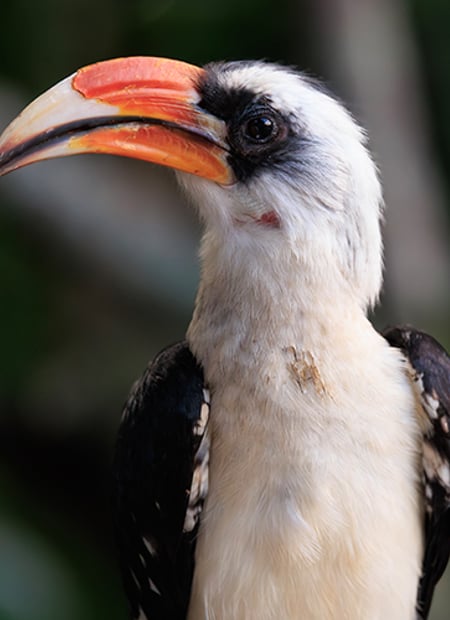
The Northern Red-billed Hornbill is a charismatic and highly recognizable bird found across the dry savannas and scrublands of sub-Saharan Africa. Distinguished by its striking, bright red, downward-curving bill and striking black-and-white patterned plumage, this species is highly adapted to arid environments. They are primarily ground-foragers, spending significant portions of their day walking and hopping through dry grass to capture insects, scorpions, and small reptiles. Notably, they exhibit a unique nesting behavior where the female is sealed inside a tree cavity with mud, relying entirely on the male to provide food through a narrow vertical slit until the chicks are large enough to fledge.
Northern Red-billed Hornbill Quick Facts
Frequently Asked Questions About the Northern Red-billed Hornbill
The female seals herself inside a tree cavity using mud, droppings, and fruit pulp to protect her eggs and vulnerable chicks from predators like snakes and monkeys.
They are omnivorous but primarily insectivorous, frequently seen foraging on the ground for grasshoppers, beetles, scorpions, and occasionally small lizards.
The Northern Red-billed Hornbill is usually pairs or small flocks.
The Northern Red-billed Hornbill is typically diurnal.
The Northern Red-billed Hornbill is resident.
The main threats facing the Northern Red-billed Hornbill include Habitat loss and Deforestation of nesting trees.
The Northern Red-billed Hornbill population trend is currently stable.
Well-known places to look for the Northern Red-billed Hornbill include Tsavo National Park (Kenya) and Serengeti National Park (Tanzania).
Natural predators of the Northern Red-billed Hornbill include Eagles, Hawks, and Snakes.
A deeply iconic species of the African savanna, widely recognized internationally due to popular media.
The Northern Red-billed Hornbill is part of the Bucerotidae family and a Bucerotiformes order.
The Northern Red-billed Hornbill weighs about 0.15 kg, stands around 42 cm tall, reaches about 42 cm in length, and has a wingspan of about 65 cm.
The Northern Red-billed Hornbill can reach speeds of around 35 km/h.