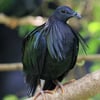
Nicobar Pigeon
Caloenas nicobarica
Also known as: Vulturine Pigeon
The Nicobar Pigeon is a large, ground-dwelling pigeon found on small islands and coastal regions from the Nicobar Islands to the Solomon Islands. It is famous for its stunning metallic green and copper iridescent feathers and long neck hackles. Genetic studies have shown it to be the closest living relative of the extinct Dodo.
Nicobar Pigeon Quick Facts
Frequently Asked Questions About the Nicobar Pigeon
The Nicobar Pigeon is nomadic (Island-hopping) and is associated with Islands, coastal forests in Southeast Asia, Pacific.
The Nicobar Pigeon can be found in Southeast Asia, Pacific and is most often associated with Islands, coastal forests.
The Nicobar Pigeon feeds on Seeds, fruit, small invertebrates and is considered a frugivore/granivore.
The Nicobar Pigeon is currently listed as Near Threatened, with a decreasing population trend. Main threats include Hunting, Habitat loss, Introduced predators.
The Nicobar Pigeon is usually flocks.
The Nicobar Pigeon is typically diurnal.
The main threats facing the Nicobar Pigeon include Hunting, Habitat loss, and Introduced predators.
The Nicobar Pigeon population trend is currently decreasing.
Well-known places to look for the Nicobar Pigeon include Nicobar Islands and Palau.
Natural predators of the Nicobar Pigeon include Monitor lizards, Rats, and Cats.
Celebrated for its unique connection to the dodo.
The Nicobar Pigeon is part of the Columbidae family and a Columbiformes order.
The Nicobar Pigeon weighs about 0.5 kg, stands around 40 cm tall, reaches about 40 cm in length, and has a wingspan of about 75 cm.
The Nicobar Pigeon can reach speeds of around 40 km/h.