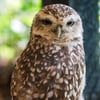
Little Owl
Athene noctua
The Little Owl is one of Europe's smallest owl species, instantly recognisable by its bright yellow eyes, flat-topped head, and characteristic bobbing motion when alert. Unlike most owls, it is frequently active during daylight hours, often seen perched openly on fence posts, barn roofs, or old trees while scanning for prey. It favours open farmland, orchards, and parkland with mature trees or old buildings for nesting, and was introduced to Britain in the 19th century, where it has since become well established across much of lowland England and Wales.
Little Owl Quick Facts
Frequently Asked Questions About the Little Owl
Unlike most owls, the Little Owl is often crepuscular or even active in daylight, frequently seen perched openly on posts, barns, and bare branches hunting insects and small prey.
The Little Owl can be found in Europe, North Africa, Asia and is most often associated with Farmland, orchards, parkland.
The Little Owl feeds on Insects, small mammals, earthworms and is considered a carnivore.
The Little Owl is currently listed as Least Concern, with a stable population trend. Main threats include Habitat loss, Pesticide use.
The Little Owl is usually solitary/pairs.
The Little Owl is typically crepuscular.
The Little Owl is resident.
The main threats facing the Little Owl include Habitat loss and Pesticide use.
The Little Owl population trend is currently stable.
Well-known places to look for the Little Owl include Cotswolds (UK) and Norfolk (UK).
Natural predators of the Little Owl include Foxes, Larger owls, and Birds of prey.
Sacred bird of the Greek goddess Athena, and a symbol of wisdom depicted on ancient Athenian coins.
The Little Owl is part of the Strigidae family and a Strigiformes order.
The Little Owl weighs about 0.18 kg, stands around 22 cm tall, reaches about 22 cm in length, and has a wingspan of about 56 cm.
The Little Owl can reach speeds of around 30 km/h.