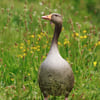
Greylag Goose
Anser anser
Also known as: Graylag Goose
The Greylag Goose (Anser anser) is a large, robust grey goose native to wetlands across Europe and western Asia. Highly social and often migratory, greylags travel in characteristic V-shaped flocks and are the wild ancestor of many domestic geese breeds.
Greylag Goose Quick Facts
Frequently Asked Questions About the Greylag Goose
The Greylag Goose is migratory and is associated with Wetlands, marshes, lakes, and agricultural fields in Europe and Asia.
The Greylag Goose can be found in Europe and Asia and is most often associated with Wetlands, marshes, lakes, and agricultural fields.
The Greylag Goose feeds on Grasses, roots, grains, and aquatic plants and is considered a herbivore.
The Greylag Goose is currently listed as Least Concern, with a increasing population trend. Main threats include Habitat drainage, Hunting.
The Greylag Goose is usually gregarious (flocks).
The Greylag Goose is typically diurnal.
The main threats facing the Greylag Goose include Habitat drainage and Hunting.
The Greylag Goose population trend is currently increasing.
Well-known places to look for the Greylag Goose include Norfolk Broads (UK) and Wadden Sea (Europe).
Natural predators of the Greylag Goose include Foxes, Eagles, and Large gulls (on goslings).
Fundamental in the history of animal domestication.
The Greylag Goose is part of the Anatidae family and an Anseriformes order.
The Greylag Goose weighs about 3.3 kg, stands around 80 cm tall, reaches about 80 cm in length, and has a wingspan of about 160 cm.
The Greylag Goose can reach speeds of around 64 km/h.