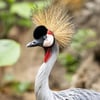
Grey-crowned Crane
Balearica regulorum
Also known as: Crested Crane
The Grey-crowned Crane is a tall, elegant crane native to eastern and southern Africa. It is easily identified by the golden, crown-like feathers on its head. These cranes frequent wetlands and grasslands and are renowned for elaborate courtship dances.
Grey-crowned Crane Quick Facts
Frequently Asked Questions About the Grey-crowned Crane
The Grey-crowned Crane is nomadic and is associated with Wetlands, marshes, floodplains in Sub-Saharan Africa.
The Grey-crowned Crane can be found in Sub-Saharan Africa and is most often associated with Wetlands, marshes, floodplains.
The Grey-crowned Crane feeds on Insects, seeds, small vertebrates and is considered a omnivore.
The Grey-crowned Crane is currently listed as Endangered, with a decreasing population trend. Main threats include Illegal trade, Habitat loss.
The Grey-crowned Crane is usually gregarious.
The Grey-crowned Crane is typically diurnal.
The main threats facing the Grey-crowned Crane include Illegal trade and Habitat loss.
The Grey-crowned Crane population trend is currently decreasing.
Well-known places to look for the Grey-crowned Crane include Maasai Mara (Kenya) and Uganda Wetlands.
Natural predators of the Grey-crowned Crane include Hyenas, Large eagles, and Humans.
The national bird of Uganda, featured on its flag.
The Grey-crowned Crane is part of the Gruidae family and a Gruiformes order.
The Grey-crowned Crane weighs about 3.5 kg, stands around 100 cm tall, reaches about 110 cm in length, and has a wingspan of about 200 cm.
The Grey-crowned Crane can reach speeds of around 50 km/h.