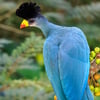
Great Blue Turaco
Corythaeola cristata
The Great Blue Turaco is the largest species of turaco, native to the canopies of sub-Saharan African rainforests. It has a striking appearance with turquoise-blue plumage, a raised black crest, and a yellow-and-red beak. While they are poor long-distance fliers, they are extremely agile climbers, leaping and running through tree branches in small family groups.
Great Blue Turaco Quick Facts
Frequently Asked Questions About the Great Blue Turaco
They are weak fliers and prefer to run and hop along branches, using their strong feet to climb high into the forest canopy.
Like other turacos, they possess unique copper-based pigments (turacin and turacoverdin) that produce their bright red and green-blue colors.
The Great Blue Turaco is usually small family groups.
The Great Blue Turaco is typically diurnal.
The Great Blue Turaco is resident.
The main threats facing the Great Blue Turaco include Habitat fragmentation, Deforestation, and Hunting for feathers and meat.
The Great Blue Turaco population trend is currently decreasing.
Well-known places to look for the Great Blue Turaco include Kibale National Park (Uganda), Kakamega Forest (Kenya), and Ituri Rainforest (DRC).
Natural predators of the Great Blue Turaco include Large birds of prey, Monkeys, and Arboreal snakes.
Their beautiful blue and green tail feathers are highly prized in traditional West African ceremonies and headwear.
The Great Blue Turaco is part of the Musophagidae family and a Musophagiformes order.
The Great Blue Turaco weighs about 0.95 kg, stands around 73 cm tall, reaches about 73 cm in length, and has a wingspan of about 75 cm.
The Great Blue Turaco can reach speeds of around 25 km/h.