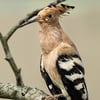
Eurasian Hoopoe
Upupa epops
Also known as: Common Hoopoe
The Eurasian Hoopoe (Upupa epops) is a striking insectivorous bird recognisable by its cinnamon plumage, distinctive crest, and long decurved bill. Found across Europe, Asia and North Africa, hoopoes feed on insects and other invertebrates, probing soil and short grass with their bills.
Eurasian Hoopoe Quick Facts
Frequently Asked Questions About the Eurasian Hoopoe
The Eurasian Hoopoe is migratory and is associated with Open countryside, orchards, parks in Europe, Asia, Africa.
The Eurasian Hoopoe can be found in Europe, Asia, Africa and is most often associated with Open countryside, orchards, parks.
The Eurasian Hoopoe feeds on Insects, larvae, small reptiles and is considered a insectivore.
The Eurasian Hoopoe is currently listed as Least Concern, with a stable population trend. Main threats include Habitat fragmentation, Intensive farming.
The Eurasian Hoopoe is usually solitary/pairs.
The Eurasian Hoopoe is typically diurnal.
The main threats facing the Eurasian Hoopoe include Habitat fragmentation and Intensive farming.
The Eurasian Hoopoe population trend is currently stable.
Well-known places to look for the Eurasian Hoopoe include Southern Europe and Savannahs of Africa.
Natural predators of the Eurasian Hoopoe include Birds of prey and Cats.
King of the birds in Persian literature and the national bird of Israel.
The Eurasian Hoopoe is part of the Upupidae family and a Bucerotiformes order.
The Eurasian Hoopoe weighs about 0.07 kg, stands around 28 cm tall, reaches about 29 cm in length, and has a wingspan of about 46 cm.
The Eurasian Hoopoe can reach speeds of around 40 km/h.