Eurasian Eagle-Owl
Bubo bubo
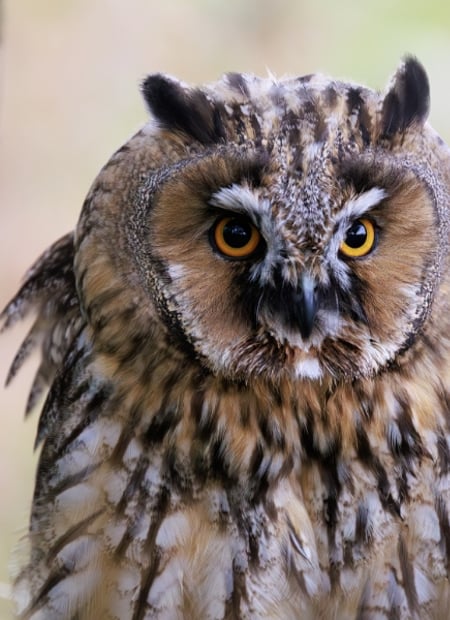
The Eurasian Eagle-Owl is one of the largest and most powerful owl species in the world, renowned for its massive size, prominent ear tufts, and striking orange eyes. Primarily nocturnal, this apex predator inhabits a variety of landscapes including coniferous forests, rocky cliffs, and mountainous regions across Europe and Asia. Using its incredibly strong talons and silent flight, it hunts a wide range of prey from small rodents and birds to larger mammals like hares.
Eurasian Eagle-Owl Quick Facts
Frequently Asked Questions About the Eurasian Eagle-Owl
The Eurasian Eagle-Owl is found across much of Europe and Asia, particularly favoring remote, rocky cliffs, gorges, and mountainous woodland regions.
It is one of the largest owls in the world, with a wingspan that can range from 160 to 188 cm (approximately 5 feet 3 inches to 6 feet 2 inches).
Its talons are incredibly powerful, exerting a squeezing force comparable to that of a large eagle, which enables it to take down substantial prey such as hares and even young deer.
The Eurasian Eagle-Owl is usually solitary or monogamous pairs.
The Eurasian Eagle-Owl is typically nocturnal.
The Eurasian Eagle-Owl is resident.
The main threats facing the Eurasian Eagle-Owl include Electrocution on power lines, Traffic collisions, and Habitat disturbance.
The Eurasian Eagle-Owl population trend is currently decreasing.
Well-known places to look for the Eurasian Eagle-Owl include Pyrenees Mountains (Spain/France), Danube Delta (Romania), Bialowieza Forest (Poland), and Ural Mountains (Russia).
Natural predators of the Eurasian Eagle-Owl include None (as adults).
The Eurasian Eagle-Owl is part of the Strigidae family and a Strigiformes order.
The Eurasian Eagle-Owl weighs about 2.7 kg, reaches about 67 cm in length, and has a wingspan of about 170 cm.