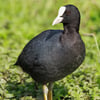
Eurasian Coot
Fulica atra
Also known as: Common Coot, Coot
The Eurasian Coot (*Fulica atra*) is a highly adaptable and distinctive waterbird featuring a soot-black body, contrasting white bill, and a prominent white frontal shield on its forehead. Widely distributed across freshwater lakes, slow-moving rivers, marshes, and urban park ponds throughout Europe, Asia, Australia, and Africa, this species is a familiar sight in wetland habitats. Though it resembles ducks in its swimming behavior and general shape, it belongs to the rail family (Rallidae). One of its most remarkable physical adaptations is its large, blue-grey lobed toes rather than webbed feet. These lobes fold back with every step to facilitate walking on soft mud and vegetation, and expand when swimming to provide powerful propulsion. Coots are highly territorial and aggressive during the breeding season, often engaging in dramatic territorial battles, but they gather in large, gregarious flocks during the winter months.
Eurasian Coot Quick Facts
Frequently Asked Questions About the Eurasian Coot
The Eurasian Coot can be found in Europe, Asia, Africa, and Australia, and is most often associated with freshwater lakes, ponds, reservoirs, marshes, and canals.
The Eurasian Coot feeds on aquatic plants, seeds, insects, small fish, and snails, and is considered an omnivore.
The Eurasian Coot is currently listed as Least Concern, with a stable population trend. Main threats include habitat loss, water pollution, and hunting in some regions.
The Eurasian Coot is usually gregarious (flocks outside breeding season).
The Eurasian Coot is typically diurnal.
The Eurasian Coot is migratory and resident.
The main threats facing the Eurasian Coot include Habitat loss, Water pollution, and Hunting.
The Eurasian Coot population trend is currently stable.
Well-known places to look for the Eurasian Coot include Attenborough Nature Reserve (UK) and Slimbridge Wetland Centre (UK).
Natural predators of the Eurasian Coot include Foxes, Birds of prey, and Large pike.
Common symbol of wetland habitats, featured in historical idioms like 'bald as a coot'.
The Eurasian Coot is part of the Rallidae family and a Gruiformes order.
The Eurasian Coot weighs about 0.75 kg, stands around 37 cm tall, reaches about 37 cm in length, and has a wingspan of about 75 cm.
The Eurasian Coot can reach speeds of around 25 km/h.