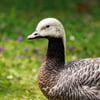
Emperor Goose
Anser canagicus
Also known as: Beach goose, Painted goose
The Emperor Goose is a small, stocky goose of the Bering Sea, with blue-grey plumage finely scaled in black and white, a white head and hindneck, a black throat and bright orange legs. It breeds on coastal tundra in western Alaska and north-eastern Siberia, and spends the winter along the rocky shores of the Aleutian Islands, the Alaska Peninsula and Kodiak. More closely tied to the sea than any other goose, it grazes salt-marsh plants in summer and forages for seaweed and shellfish in the intertidal zone in winter.
Emperor Goose Quick Facts
Frequently Asked Questions About the Emperor Goose
The Emperor Goose makes a relatively short migration, moving from its tundra breeding grounds in western Alaska and Siberia to winter along the coasts of the Aleutian Islands, the Alaska Peninsula and Kodiak Island.
The Emperor Goose is found almost entirely around the Bering Sea. Most of the population breeds on the Yukon-Kuskokwim Delta in Alaska, with smaller numbers on the Chukotka coast of Russia.
In summer it grazes on sedges, grasses and berries in coastal marshes. In winter it feeds in the intertidal zone on sea lettuce, eelgrass and other seaweeds, as well as mussels and clams.
The Emperor Goose is listed as Least Concern, having previously been classed as Near Threatened. Numbers fell sharply between the 1960s and 1980s and have since partly recovered, but its small range leaves it vulnerable to hunting pressure, oil spills and climate change.
The Emperor Goose is usually pairs in the breeding season; small flocks in winter.
The Emperor Goose is typically diurnal.
The main threats facing the Emperor Goose include Hunting pressure, Oil spills and pollution in coastal waters, and Climate change and coastal flooding of nesting areas.
The Emperor Goose population trend is currently recovering from 1980s lows.
Well-known places to look for the Emperor Goose include Yukon-Kuskokwim Delta (Alaska) and Aleutian Islands and Kodiak Island (winter).
Natural predators of the Emperor Goose include Arctic and red foxes, Glaucous gulls and jaegers (eggs and chicks), and Bald and golden eagles.
A traditional subsistence species for Yup'ik communities in western Alaska. Hunting was closed in 1987 after the population declined, and a limited harvest reopened in 2017.
The Emperor Goose is part of the Anatidae family and an Anseriformes order.
The Emperor Goose weighs about 2.3 kg, reaches about 68 cm in length, and has a wingspan of about 119 cm.