Common Moorhen
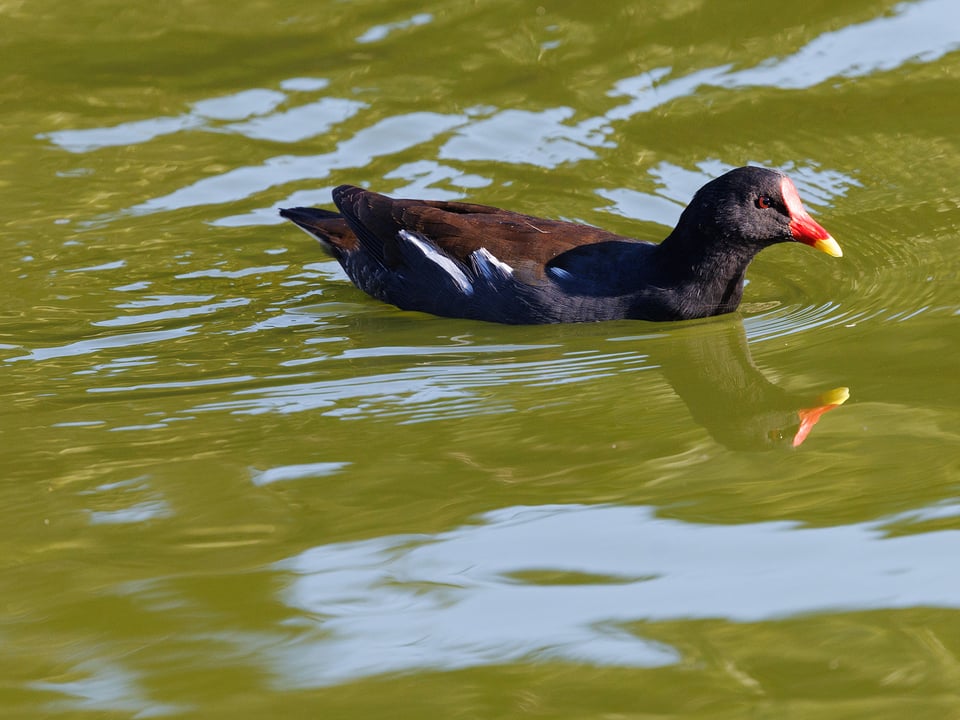
A dark waterbird with a red-and-yellow bill and white flank stripe, common on ponds, rivers and canals.
- Lifespan
- Around 3 years (wild)
- Habitat
- Ponds, lakes, rivers, canals and marshes
- Diet
- Water plants, seeds, insects, snails and worms
- Region
- Europe, Asia and Africa
01 — Gallery
Common Moorhen photographs
Select a photograph to view it full size.
02 — Field guide
Getting to know the Common Moorhen
The Common Moorhen is a medium-sized waterbird of the rail family, recognised by its dark slaty plumage, white flank stripe and bright red frontal shield with a yellow-tipped bill. Found across Europe, Asia and Africa, it lives on ponds, lakes, rivers, canals and marshes, including in town parks. Its long green toes let it walk over floating vegetation, and it flicks its white undertail nervously as it swims or walks.
Questions & answers
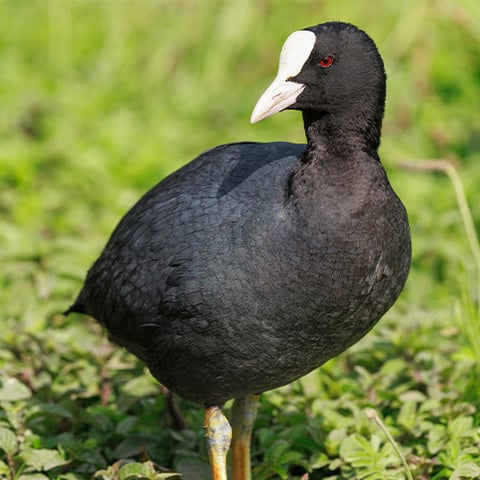
Moorhens have a red frontal shield and a yellow-tipped red bill, a white stripe along the flanks and white undertail feathers. Coots are all black with a white bill and shield, and are larger and more often seen swimming in open water.
It is found across Europe, Asia and Africa wherever there is fresh water with vegetated edges, from rural marshes to small ponds in city parks. Birds in the Americas are now treated as a separate species, the Common Gallinule.
It is an omnivore, feeding on water plants, seeds and berries as well as insects, snails, worms and other small invertebrates, both on land and in the water.
The Common Moorhen is listed as Least Concern thanks to its huge range, although local numbers can fall after hard winters or because of predation by introduced American mink.
The Common Moorhen is usually territorial in pairs or family groups when breeding; forms loose flocks in winter.
The Common Moorhen is typically diurnal.
The Common Moorhen is mostly resident; northern and eastern populations migrate south in winter.
The main threats facing the Common Moorhen include Predation by introduced American mink, Loss and drainage of wetlands, and Severe winters.
The Common Moorhen population trend is currently stable.
Well-known places to look for the Common Moorhen include Park lakes and ponds across the UK and Canals and slow-flowing rivers in Europe.
Natural predators of the Common Moorhen include American mink, Foxes, Pike (chicks), and Herons and crows (eggs and chicks).
Its name has nothing to do with moorland: 'moor' is an old word for marsh or fen, so a moorhen is simply a 'marsh hen'.
The Common Moorhen is part of the Rallidae family and a Gruiformes order.
The Common Moorhen weighs about 0.35 kg, stands around 34 cm tall, reaches about 34 cm in length, and has a wingspan of about 52 cm.