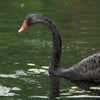
Black Swan
Cygnus atratus
Also known as: Australian Black Swan
The Black Swan is a large waterbird native to Australia, notable for its glossy black plumage and bright red bill. Unlike many swans, it is largely nomadic rather than strictly migratory and often gathers in large flocks on lakes and lagoons.
Black Swan Quick Facts
Frequently Asked Questions About the Black Swan
The Black Swan is nomadic and is associated with Lakes, rivers, wetlands in Australia, introduced elsewhere.
The Black Swan can be found in Australia, introduced elsewhere and is most often associated with Lakes, rivers, wetlands.
The Black Swan feeds on Aquatic plants, algae and is considered a herbivore.
The Black Swan is currently listed as Least Concern, with a stable population trend. Main threats include Habitat loss, Pollution.
The Black Swan is usually gregarious/pairs.
The Black Swan is typically diurnal.
The main threats facing the Black Swan include Habitat loss and Pollution.
The Black Swan population trend is currently stable.
Well-known places to look for the Black Swan include Perth (Western Australia) and Dawesville Cut.
Natural predators of the Black Swan include Sea eagles, Dingoes, and Foxes (on eggs).
The state bird of Western Australia.
The Black Swan is part of the Anatidae family and an Anseriformes order.
The Black Swan weighs about 6 kg, stands around 120 cm tall, reaches about 120 cm in length, and has a wingspan of about 180 cm.
The Black Swan can reach speeds of around 80 km/h.