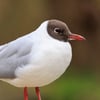
Black-headed Gull
Chroicocephalus ridibundus
Also known as: Common Black-headed Gull
The Black-headed Gull (Chroicocephalus ridibundus) is a small, adaptable gull that breeds across much of the Palearctic. Despite its name, its head is actually dark chocolate-brown during the summer breeding plumage, returning to white with a dark smudge behind the eye in winter. Highly vocal and gregarious, they are common year-round in coastal areas, inland wetlands, and increasingly in urban spaces.
Black-headed Gull Quick Facts
Frequently Asked Questions About the Black-headed Gull
The Black-headed Gull is resident or partial migrant and is associated with Coasts, estuaries, inland lakes, marshes, urban parks in Eurasia, parts of North America.
The Black-headed Gull can be found in Eurasia, parts of North America and is most often associated with Coasts, estuaries, inland lakes, marshes, urban parks.
The Black-headed Gull feeds on Insects, earthworms, fish, seeds, human food scraps and is considered a omnivore.
The Black-headed Gull is currently listed as Least Concern, with a stable population trend. Main threats include Avian influenza, Coastal development.
The Black-headed Gull is usually highly gregarious (flocks).
The Black-headed Gull is typically diurnal.
The main threats facing the Black-headed Gull include Avian influenza and Coastal development.
The Black-headed Gull population trend is currently stable.
Well-known places to look for the Black-headed Gull include Regent's Park (London) and European coastal wetlands.
Natural predators of the Black-headed Gull include Peregrine falcons, Red foxes, and Large birds of prey.
A very common sight in European cities, often swarming around people feeding waterfowl.
The Black-headed Gull is part of the Laridae family and a Charadriiformes order.
The Black-headed Gull weighs about 0.3 kg, stands around 38 cm tall, reaches about 40 cm in length, and has a wingspan of about 100 cm.
The Black-headed Gull can reach speeds of around 50 km/h.