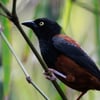
Black-and-crimson Oriole
Oriolus cruentus
Also known as: Crimson-breasted Oriole
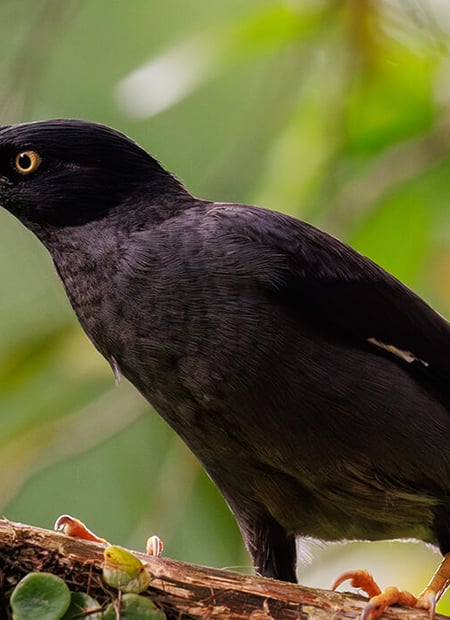
The Black-and-crimson Oriole (*Oriolus cruentus*) is a striking species of bird in the family Oriolidae, native to the montane forests of Indonesia and Malaysia. Males possess a glossy black plumage contrasted by a vibrant crimson patch on the breast and primary coverts, while females typically display a duller coloration with dark streakings. These birds inhabit the middle and upper canopy of montane and submontane environments, where they primarily forage for wild fruits, berries, and various insects.
Black-and-crimson Oriole Quick Facts
Frequently Asked Questions About the Black-and-crimson Oriole
The Black-and-crimson Oriole lives in montane forests of Sumatra, Java, Borneo, and Peninsular Malaysia, usually at elevations between 800 and 2,200 meters.
Their diet consists mainly of wild fruits, especially figs and berries, as well as nectar and insects like beetles and caterpillars.
The Black-and-crimson Oriole is currently evaluated as Least Concern by the IUCN, though they are locally vulnerable to habitat loss from deforestation in montane zones.
Males are glossy black with a bright crimson chest patch and wing patch, while females are duller, often with grey-black plumage and lack or have a much smaller, less intense red patch on the belly.
The Black-and-crimson Oriole is usually solitary, pairs, or small family groups.
The Black-and-crimson Oriole is typically diurnal.
The Black-and-crimson Oriole is resident.
The main threats facing the Black-and-crimson Oriole include Habitat degradation from agricultural clearing and Climate change impacting montane ecosystems.
The Black-and-crimson Oriole population trend is currently stable.
Well-known places to look for the Black-and-crimson Oriole include Mount Kinabalu National Park (Sabah, Borneo), Fraser's Hill (Malaysia), and Kerinci Seblat National Park (Sumatra).
Natural predators of the Black-and-crimson Oriole include Raptors, Arboreal snakes, and Small carnivores.
A prized sighting for birdwatchers in montane Southeast Asia due to its stunning contrast and shy, canopy-dwelling nature.
The Black-and-crimson Oriole is part of the Oriolidae family and a Passeriformes order.
The Black-and-crimson Oriole weighs about 0.045 kg, reaches about 22 cm in length, and has a wingspan of about 34 cm.
The Black-and-crimson Oriole can reach speeds of around 40 km/h.