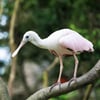
African Spoonbill
Platalea alba
Also known as: White Spoonbill (African variant)
The African Spoonbill is a long-legged wading bird found in marshy wetlands and shallow lakes across sub-Saharan Africa. It is named for its long, spatula-shaped bill, which it uses to hunt by sweeping it side-to-side through the water, snapping it shut the moment it detects prey. They are social birds, often nesting in colonies alongside herons, ibises, and storks.
African Spoonbill Quick Facts
Frequently Asked Questions About the African Spoonbill
The African Spoonbill is nomadic and is associated with Wetlands, marshes, shallow lakes in Sub-Saharan Africa.
The African Spoonbill can be found in Sub-Saharan Africa and is most often associated with Wetlands, marshes, shallow lakes.
The African Spoonbill feeds on Fish, insects, crustaceans and is considered a carnivore.
The African Spoonbill is currently listed as Least Concern, with a stable population trend. Main threats include Habitat degradation, Pollution.
The African Spoonbill is usually colonial.
The African Spoonbill is typically diurnal.
The main threats facing the African Spoonbill include Habitat degradation and Pollution.
The African Spoonbill population trend is currently stable.
Well-known places to look for the African Spoonbill include Okavango Delta (Botswana) and Kruger National Park.
Natural predators of the African Spoonbill include Crocodiles, Monitor lizards, and Hyenas.
Notable for its highly specialised feeding technique.
The African Spoonbill is part of the Threskiornithidae family and a Pelecaniformes order.
The African Spoonbill weighs about 1.6 kg, stands around 90 cm tall, reaches about 90 cm in length, and has a wingspan of about 125 cm.
The African Spoonbill can reach speeds of around 45 km/h.